

Many of us have used meat products in an important period of our lives and have seen them as an essential nutrient. As a result, there has been a continuous demand as parallel to the human population and the industry has tried to increase its capacity by making its own investments for more meat. The increase in capacity has reached such a large extent that even if consumers are not aware of it, manufacturers now understand that they are approaching the limits. So what happens next? What makes meat perceptually indispensable? In this article we will discuss them.
From past to present, people have a certain history of meat consumption; along with the hunting culture, the invention of fire, the discovery of agricultural products, and a number of innovations, domesticated animals and their use as a food has become widespread. As I mentioned in my previous article (you can find it here), some scientific publications claim that there is a link between the use of meat as a nutrient and the development of the human brain. However, there are also studies indicating that this is not the case, with the invention of fire, the agricultural products used turned into a more digestible form.
Moving to today, meat consumption has gained momentum in the 21st century, events such as the industrial revolution and the Second World War have caused a population boom, which has brought meat to a constantly increasing consumption trend. While the meat industry emphasized the nutritional characteristics of meat on the one hand, it also made a significant contribution to the increase by showing consumption in male individuals as a necessity of being “masculine”. If meat is consumed, the idea of “more masculine, more active sex life” has so much populated that its effects can be seen even today. In short, meat has been deliberately transformed on a sexual policy (I recommend reading the book Sexual Policy of Meat).
Consequently, the perception that meat consumption is a necessity with campaigns can be picked as following:
- Our ancestors are fed with meat and we have reached our current body form. Therefore, meat should be consumed.
- Meat is rich in protein and vitamin B12. If not eaten, body development stops.
- If meat is not eaten, a decrease in sexual performance occurs.
- The meat is delicious.
To be honest, I was equipped with information explaining the scientific aspects of this subject during my undergraduate education. I did not even need to read the opposite articles. (There was no incentive in this direction. When I wrote the information on the exam paper, I would probably be out of class, anyway). How accurate is this information that is taught to us, and which is constantly promoted and advertised? Will billions of people believe in an idea give information about the issue? It must be questioned and let’s start:
- Since our ancestors were fed with meat, we got our current structure: It is useful to know some historical processes in order to examine this issue.
Studies have shown that human beings started to use fire in a controlled manner approximately 1, 42 million years ago. However, studies that previously reported that people switched to regular agriculture 12,000 years ago indicate that this number goes up to 23,000 years ago in Israeli research. In other words, until we start using agricultural products, we can say that humanity’s modern brain structure is formed, and by comparing only these data, it is true. If we compare these time frames in the infographic below, it is seen that there is a serious increase in brain capacity especially with the invention of fire.
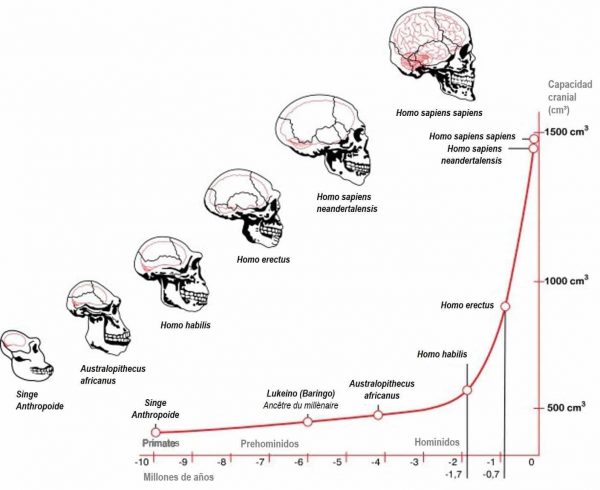
However, there is another issue to consider here: Can a clear result be got by making a comparison between the concepts of meat consumption, the invention of fire and the transition to regular agriculture in the process of evolution? To support this claim, we need to examine more anatomical structures, just as follows:
– Jaw muscles and chewing,
– Mouth openings and dental structures,
– Intestinal lengths,
– Kidney, liver and stomach structures, even stomach Ph degree
| JAW MUSCLES | CHEWING | ||
| Carnivore | Temporalis | Carnivore | No chewing; swallows food as whole |
| Herbivore | Masseter ve Pterygoids | Herbivore | longtime chewing |
| Omnivore | Temporalis | Omnivore | swallows food as whole and/or basic chewing |
| Human | Masseter ve Pterygoids | Human | longtime chewing |
| MOUTH OPENING | TOOTH (MOLAR) | |||
| Carnivore | Big | Carnivore | Sharp, pointed, like a knife | |
| Herbivore | Small | Herbivore | Jagged, flat | |
| Omnivore | Big | Omnivore | Sharp and /or flat | |
| Human | Small | Human | Bump and flat | |
| TOOTH (FRONT / INCISER) | TOOTH (DOG) | ||
| Carnivore | Short and sharp | Carnivore | Long, sharp and curve |
| Herbivore | Large and compressed (like shovel) | Herbivore | Short, blunt or long (to defend) |
| Omnivore | Short and pointed | Omnivore | Long, sharp and curved |
| Human | Large and compressed (like shovel) | Human | Short and blunt |
| INTESTINE LENGTH | LARGE INTESTINE | |||
| Carnivore | 3 to 6 times the body length | Carnivore | Basic, short and flat | |
| Herbivore | 10 to 12 times the body length | Herbivore | Long, complex structure and sometimes pieces | |
| Omnivore | 4 to 6 times the body length | Omnivore | Basic, short and flat | |
| Human | 10 to 11 times the body length | Human | Long and pieces | |
| KIDNEY | LIVER | ||
| Carnivore | Very concantreted urine | Carnivore | Vitamin A can be detoxified (+) |
| Herbivore | Moderate concantreted urine | Herbivore | Vitamin A cannot be detoxified (-) |
| Omnivore | Very concantreted urine | Omnivore | Vitamin A can be detoxified (+) |
| Human | Moderate concantreted urine | Human | Vitamin A cannot be detoxified (-) |
| CAPACITY
OF STOMACH |
STOMACH pH | ||
| Carnivore | % 60-70 of total volume of gastrointestinal tract | Carnivore | pH 1 or lower |
| Herbivore | Lesser than % 30 of total volume of gastrointestinal tract | Herbivore | pH 4 – 5 |
| Omnivore | % 60-70 of total volume of gastrointestinal tract | Omnivore | pH 1 or lower |
| Human | % 21-27 of total volume of gastrointestinal tract | Human | pH 1 – 2 |
| STOMACH | PTYSMA | ||
| Carnivore | Basic | Carnivore | No digestive enzyme in mouth |
| Herbivore | Basic or multiple zones | Herbivore | Digestive of carbonhydrate starts in mouth |
| Omnivore | Basic | Omnivore | No digestive enzyme in mouth |
| Human | Basic | Human | Digestive of carbonhydrate starts in mouth |
This is how we can sum up comparisons at the anatomical level. You can reach the source from the link https://tvd.org.tr/kilavuz/anatomi/
- In case of not being eaten meat, protein and B12 cannot be taken enough, otherwise human development stops: This is the doctrine that has been dug into another brain. The protein ratio of legumes, nuts and plant seeds is not less than meat. You can reach the comparative table by clicking here. The wrong perception about vitamin B12 is that animals are produced and if we don’t eat meat, we cannot get vitamin B12. B12 is a vitamin synthesized by bacteria that grow in the soil. Because the animals are grazing, they also take these bacteria in the soil, but the application in modern industry is aimed at closing the gap by giving the B12 needle to the animals. Since it cannot be synthesized in the human body, it must be taken from the outside.
- Sexual performance of meat-eating men improves: Who made this perception, why and how did it emerge? I am sure that there is nobody who can explain these myths in plasuable scale When meat is consumed, bacteria in the intestinal flora turn carnitine into trimethylamine and in the liver to trimethylamine oxide. This molecule pushes cholesterol to the arterial wall, accelerating plaque formation and slowing blood flow. On the contrary, there are decreases in sexual performance. At this point, it turns out that there is a political orientation such as getting the man into a hunter position.
- The meat is so delicious that I cannot give up: While it is claimed that the meat is delicious, it is useful to keep in mind food processes (salt, sugar, monosodium glutamate and hundreds more) and many chemicals, heat treatment, etc.. There are also studies related to this perception in humans, I will touch on.
WHAT IS NEXT?
Demand is constantly increasing, with billions of dollars spent on such intense campaigns and consumer referrals. The situation in 2050 is expected to be as follows by FAO.

Another fact that these predictions try to explain will be in the environmental destruction it will create. As seen below, the greenhouse gases that cause the warming of the world bring serious discussions in the livestock sector, especially meat products, until 2050.

OTHER ALTERNATIVES OF MEAT BASED PRODUCTS
While this frightening picture in 2050 is clear, I would like to mention some of the work done in this area. Some start-up groups, private sector and educational institutions have made a serious effort to meet upward trend in meat demand of people. If those who enter this race can get their discoveries accepted, they are aware that they will earn a significant amount of money financially.
One of those who invested in this issue is an initiative called “impossible foods”. The company tried to find out why people could not give up meat and managed to produce some alternative burgers. The main concern of this study was that which factors played role in tasting mechanism of individuals and to find the reasons that make it impossible to give up the meat products. What they claimed was that “hemi iron, as named Fe + 2” played a big role in the meat preference. When they add hemi iron to their products, especially in sensory analyzes performed in children, it has been found that they have difficulties in detecting the difference between the burger made from real meat and the plant content.
The absorption of hemi iron (Fe + 2) is higher than that of non-hemi iron (Fe + 3). 40% of the iron in meat is both iron and absorption is 25-30%.
The fact that hemi iron is such important in the selection of meat and the use of burgers sold as a commercial product can bring serious health consequences. Since hemi iron is an animal based content, it exists in meat, chicken, fish and other same foods. However, according to a study which conducted with 130 thousand patients, it was found that hemi iron, taken more than 1 mg per day, increased coronary heart diseases by 27%. (I recommend watching the Game Changers documentary)
This scientifical discover, in process of producing plant based meat products, is expected to fasten the current trend on creating meat alternatives.
Another alternative is to develop meat cells in laboratories and turn them into hamburgers. But the fact that the concept of laboratory meat scares people seems to be an important obstacle to its commercial success.
CONCLUSION
It is clearly seen that the search for meat substitution will accelerate in the coming periods and companies will try to get a share from this market as early as possible. Of course, I feel that looking at this situation with suspicion will become helpful, so that, even if you switch to meat substitute products, it will be necessary to ask and follow the questions about how to make them, what will be their environmental effects, and what kind of ingredients will be used to imitate meat taste.
References