

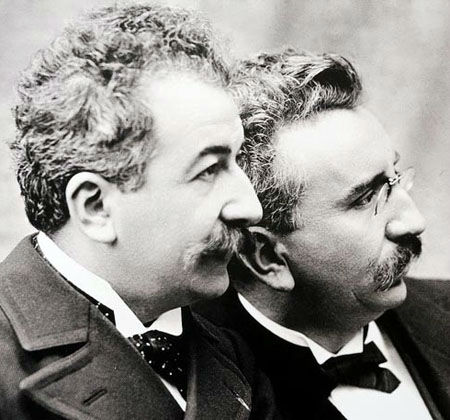
 Cinema history begins with the brothers Louise and Auguste Lumiere. In one of their shows, the audience is even said to have fled under their chairs, fearing that the train moving from the curtain will come over them. From the first screenings on March 22, 1895 to the present day, cinema has evolved in itself within the framework of the events developing in the world and different kinds of currents have emerged. These trends can be collected as Expressionism, Poetic Realism, New Realism, New Wave, Free Cinema, New Cinema, Experimental Cinema, Constructivism and Futurism.
As a result of the destruction caused by the Second World War, cinema has entered an important period due to the worsening of living conditions and social problems, and countries have started to reflect the problems that have emerged on the screen with the Soviet Socialist Cinema, the British Document Film School, New Realism in Italy, the “New Wave” cinema movement occurred in France in 1950.
With New Wave Cinema, filming has been started more frequently in the external environment, and emphasis has been placed on social problems, political views, criticisms and references. The fact that the scenes and events do not follow each other, the topics progress by jumping, the ability to handle different topics creates an uncertainty about what will happen in the next scenes. Identification between characters evolves into alienation more frequently in the New Wave Cinema. In addition, a significant portion of the movie scenarios made in this trend were again written by the directors. We can say that individuality is in the spirit of this cinema.
In French New Wave Cinema, Jacques Rivette, Claude Chabrol, Francois Truffaut, Louis Malle, Éric Rohmer, Agnés Varda and Jean-Luc Godard are the leading representatives.

Ideologically, Godard having Marxist and an existentialist wiev, he made this idea felt own films. His political films include the Chinese Girl (La Chinoise, 1967), Weekend (Weekend, 1967), Pravda (1969), Eastern Winds (Vents d’Est, 1969), Struggles in Italy (Luttes en Italie, 1969) and Until Victory ( Jusqu la Vitoire, 1970) are examples. Of course, one should not skip Le Petit Soldat (Little Soldier, 1963), which was banned for three years.
À bout de Souffle directed by Godard in 1960 brought him to the milestone of the new wave because Godard shot this film entirely with a handheld camera and without using artificial light.
 In Pierrot Le Fou (Crazy Pierrot, 1965), Ferdinand, who is married, gets bored with life and his wife, escaping with Merianne and the crimes he committed, and his search for meaning for life, existed in existential pain. Clearly, we often encounter relationships and references between men and women.
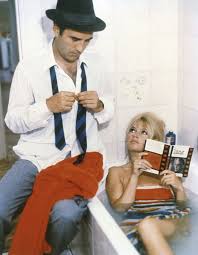 Le Mepris (Hate, 1965) made a sarcastic approach to American imperialism. As for the point of film, a theater copywriter who endeavours to meet the wishes of his wife and to buy a new house, the acceptance of the American film financer’s offer of writing a cinema text, and the concessions he made from his thoughts, and the problems with his wife were explained in a very beautiful language.
Another interesting detail is the fact that Anna Karina, who she was her ex-wife and played in movies, stated that the lines in the movie were written by Godard at the moment and that she did not know what would happen when the movie was shot, from my view, it was the peak of extraordinaryness and creativity.
Undoubtedly, there is a lot to say about French New Wave Cinema and Godard, but I can say that these waves and director films will be a good choice for those who are bored with popular cinema and films which are identical each other of Holywood. Despite the features such as holywood and popular culture cinema giving the whole plot order without giving the viewer a chance to think and the end of the movie can be easily predicted, French New Wave Cinema presents an opportunity to think for viewers about way of film and it gives a pleasant effect on the audience upon life-oriented inquiries.
References
http://www.otekisinema.com/lumiere-kardesler/ Erişim 17.11.2018
https://www.sineplusakademi.com/sinema-akimlari/ Erişim 17.11.2018
https://www.wannart.com/fransiz-yeni-dalga-akimi/ Erişim 17.11.2018
http://www.perasinema.com/sinemanin-isyankar-akimi-yeni-dalga/ Erişim 17.11.2018
https://godardsinemasi.wordpress.com/filmografi/ Erişim 17.11.2018
Odabas, B (1994). Fransız sinemasında Yeni Dalga. Marmara İletişim Dergisi. 5, 282-284. Erişim 17.11.2018, http://dergipark.gov.tr/download/article-file/2757